AI Has Taken Away Homework’s Alibi
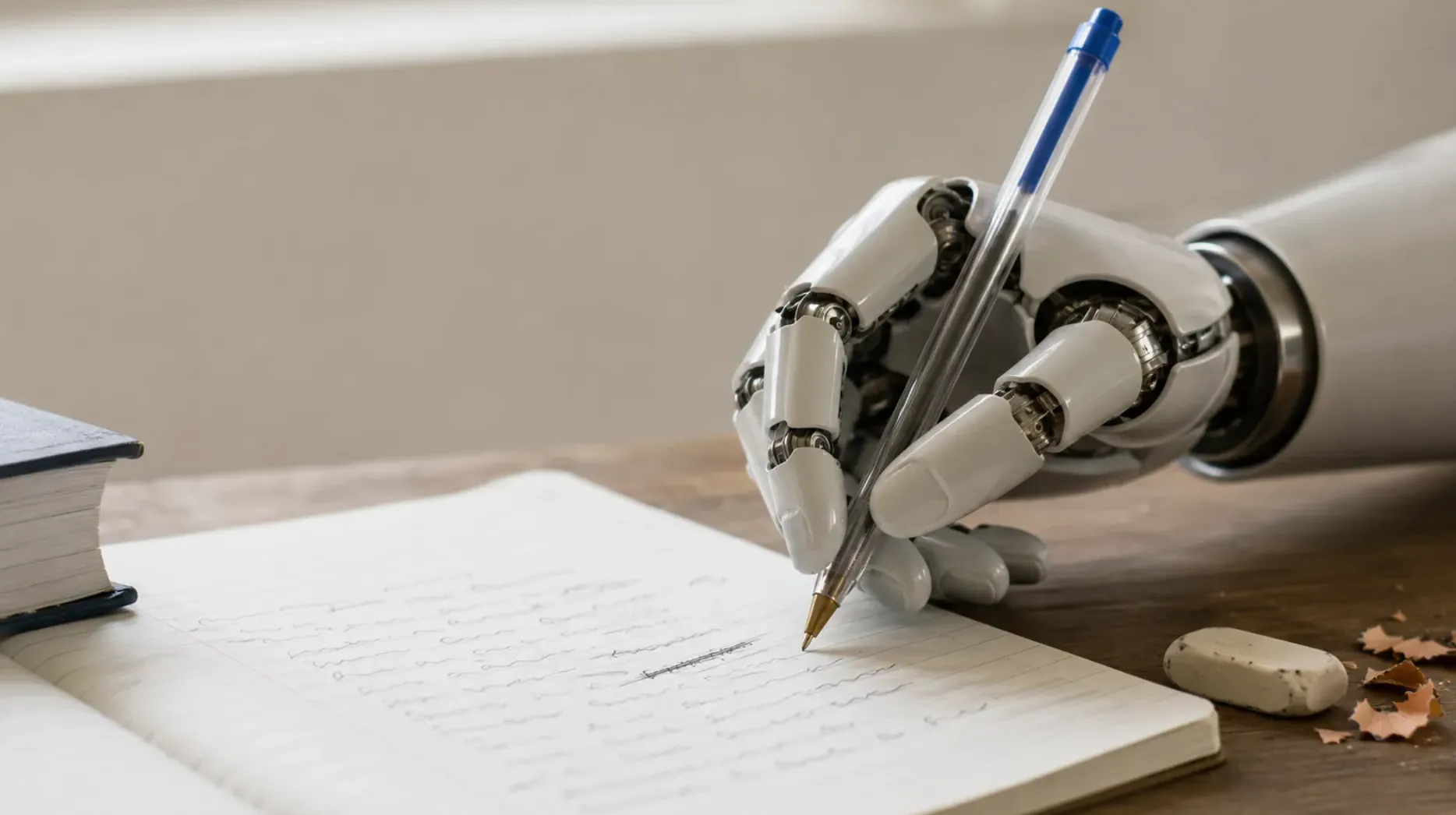
Homework used to carry a simple assumption: the student had done it themselves. With generative AI, that can no longer be taken for granted.
Behind a polished essay there may be an evening of reading, thinking and editing. Or there may be one good prompt and six minutes spent replacing a word like “multifaceted” with something a teenager might actually say. On the page, both can look equally convincing.
Teachers are now looking for suspicious vocabulary, unusually polished phrasing and punctuation that feels almost too perfect. A sentence such as “This demonstrates the complex interplay between…” can suddenly attract attention. Schools have also turned to AI detectors, but these rarely settle the question. A detector flags an essay, the student denies using AI, and the teacher cannot prove otherwise. In the end, nobody learns very much, but everyone gets a small taste of a courtroom drama.
Meanwhile, homework is getting harder
Teachers know that AI can produce 800 words in seconds, so the assignment becomes 1,500. A standard essay turns into a comparative analysis. Three sources become eight. Then come the presentation, reflection and annotated bibliography — presumably to make sure nobody has an evening left.
The logic is understandable. Teachers cannot confidently assess work that may have taken less time to produce than it takes to type a prompt.
But this creates a strange kind of inflation. AI makes homework easier to produce, so schools make homework more demanding. Students who use AI can simply ask it to do more. Students who work independently spend twice as long, yet their work may still look less polished.
The bar keeps rising, but not everyone has the same ladder.
That is why the discussion should not be reduced to one question: “How do we stop students cheating?” A more important question is what education should look like when producing a convincing answer is no longer difficult.

Still from Gossip Girl / The CW / Warner Bros. Television
Education has faced changes like this before
AI will inevitably change education in significant ways. The shift may prove even more disruptive than the arrival of the internet. There was a time when searching for information online could itself be treated as a form of cheating. Gradually, schools recognised that knowing how to find information is not the same as avoiding learning.
For a while, the internet seemed to offer education a chance to move beyond memorisation. There was little value in rewarding students simply for remembering facts that could be found in seconds. Schools could instead focus more on interpretation, critical evaluation and the ability to apply knowledge well.
But that shift was incomplete. Facts moved from textbooks into online quizzes, yet students were still often rewarded for recalling the correct answer rather than showing that they understood how to use what they had learned.
AI gives education another chance. This time, we should try not to waste it.
Three homework formats worth trying
Instead of making homework longer, schools can design tasks that require students to think, judge and apply what they know.
Here are three approaches worth trying.
- Give students an AI-generated answer and ask them to identify its three weakest claims.
- Ask them to choose the most convincing argument discussed in class and explain what evidence could make them change their mind.
- Ask students to apply what they have learned to something specific around them. Instead of asking them to explain persuasive language, ask them to bring in an advertisement and identify which line is doing the most persuasive work. Instead of describing climate change in general, ask which part of their city would be most affected by extreme heat and why.
These assignments do not need to be longer. They simply require students to make decisions. And those decisions can reveal far more about understanding than 1,500 perfectly structured words.
In real life, we rarely use knowledge by sitting alone and trying to recall every fact we know. We search, compare, question, discuss and decide. Education should assess those abilities rather than treating memorisation as the highest form of understanding.
The question schools should be asking
The most important question is no longer: “Did this student use AI?” It is: “Does this student understand the material?”
One student may use AI to explain a difficult concept and then write the assignment independently. Another may generate the entire response and submit it without reading beyond the first paragraph.
Both used AI. Only one stopped thinking for themselves.
AI has not destroyed homework. It has simply exposed how little a finished piece of work can prove — and how often education still rewards the production of answers rather than the application of knowledge.
A page can tell us that an answer exists. It can no longer reliably tell us who produced the thinking behind it, or whether much thinking happened at all.
This time, schools should learn the lesson.