What Do Parents Expect from School Communication in 2026?

Picture a typical morning for a parent of a school-age child. An email arrives about an upcoming school trip. The school app sends a notification about a timetable change. A teacher messages about homework, while the parent group chat is discussing a new form that needs to be completed by Friday.
On its own, each message seems useful. Taken together, however, they turn into a small puzzle: you have to work out what applies to your child, where to find the latest information, and whether you need to take any action.
In recent years, schools have gained more digital tools for communicating with families. But that has not always made communication simpler. In fact, the more channels there are, the greater the risk that important information will get lost among dozens of notifications.
So what do parents really expect fr om their school? Constant real-time updates? The ability to message a teacher at any moment? Or a single app that solves every problem?
Research suggests that their main priority is something else. Parents do not need more messages; they need less uncertainty. They want to understand quickly what is happening, wh ere to find the information they need, and whether they are expected to do anything.

Still: “Bad Moms” / STX Entertainment / Huayi Brothers Pictures
Why are there more digital tools, but not always more clarity?
Just a few years ago, online gradebooks, school apps, and digital timetables felt like a major step forward. They reduced schools’ reliance on paper notices and made communication with families faster.
However, digitisation solved only the problem of delivering information. It did not guarantee that parents would be able to find the right message easily, understand it, and act on it when needed.
Research supports this.
In 2024, SchoolStatus surveyed 1,050 US parents of school-age children to understand how well communication between families and schools currently works. More than half said that information from their school can be difficult to find and understand, while almost two-thirds said they would like a single central hub for school communication.
This does not mean that every form of communication has to move into one app. Different channels still serve different purposes. An urgent notice about a school closure makes sense as an SMS or push notification. A detailed letter from the headteacher is easier to read by email. Timetables, documents, and message history are best stored in a parent portal.
Problems begin when there is no clear system connecting these channels. Parents no longer know wh ere to look for information about a school trip, which platform to use to check grades, or whether a message in a group chat should be treated as official.
Other studies show a similar pattern. Parents generally find digital tools convenient, but email remains the channel through which they most often receive important information. School apps and portals are used less frequently, so communication is still fragmented.
In other words, parents are not opposed to digital tools. They simply expect those tools to work together, rather than forcing them to piece together the full picture fr om several different sources.
What information do parents actually want from their school?
When people think about school communication, grades are often the first thing that comes to mind. But parents want more than final results. They also want to understand how their child is progressing and how they can support them.
That does not mean they need a full report after every lesson. Short, focused updates can be far more useful.
For example:
- what topic the class is currently studying;
- which tasks their child is finding difficult;
- where their child is already making progress;
- which assignments are coming up;
- which deadlines are approaching;
- what would be useful to review at home.
How the school phrases its messages is just as important.
Consider the following message:
“Please review the updated school policy.”
It only tells parents that a new document exists. It immediately raises questions: What has changed? Does this affect my child? Do I need to sign anything? Wh ere can I find the document itself?
Now compare it with this message.
“On Friday, 16 October, at 6:00 p.m., we will hold an online meeting for parents of Year 9 students. We will explain how GCSE subject choices work and how they may affect your child’s future study options. Please register by 14 October. Questions can be submitted to the school adviser in advance through the app.”
After reading a message like this, parents immediately understand who it is for, why it was sent, and what action they need to take. The less information families have to clarify separately, the lighter the workload for teachers and school administrators.
Effective communication, however, depends on more than clear wording. It also matters why the school is contacting the family. Even the clearest notifications will not build trust if parents hear fr om the school only when something has gone wrong.
Should schools contact parents only when there is a problem?
Imagine that a school contacts a family only in three situations: their child receives a low grade, misses a lesson, or breaks a behaviour rule.
Over time, every new notification starts to trigger the same reaction: “Something must have gone wrong again.”
Communication gradually becomes a source of anxiety rather than a tool for collaboration. Parents see isolated problems but never gain a complete picture of their child’s school experience.
This does not mean the school should send a message every time a student completes their homework successfully. But occasional positive updates can significantly change how families perceive communication with the school.
For example:
“Today, Ethan volunteered to present his group’s work. He used to find speaking in front of the class difficult, but over the past few weeks he has become noticeably more confident.”
This kind of message requires no action from parents. What it does show is that the teacher notices not only the child’s mistakes, but also their progress and achievements.
Trust with families needs to be built in advance, not only when difficulties arise. When open communication has already become the norm between school and home, challenging situations are much easier to discuss.
Balance still matters, of course. If parents receive dozens of notifications every day, even the most positive messages will quickly lose their value.
Parents need more than a way to give feedback — they need to see what happens next
Modern school communication is no longer one-way. Parents want not only to receive information, but also to ask questions, share suggestions, and understand what happens after they get in touch. Teachers do not need to be available around the clock. What matters far more is that families know wh ere to go, who can help, and when they can expect a response.
Research shows that most parents find it easy to provide feedback, but far fewer feel that their views genuinely influence school decisions. Only around half of those surveyed received an explanation of how their suggestions had been used in practice. Collecting feedback is therefore only half the job. Schools also need to explain what changed as a result.
For example, after surveying families about the timing of parent meetings, a school might say:
“Many parents told us that evening meetings are difficult to attend because of their work schedules. From next term, some meetings will therefore be held online, and recordings of the presentations will be available in the parent portal.”
This approach shows that the school listened to parents, made a decision, and explained the reasoning behind it. A complete feedback loop works exactly like this: the school asks a question, gathers responses, makes a decision, and communicates the outcome. Trust is built not simply when it is easy to contact the school, but when families can see that their views are genuinely taken into account.
So, what do parents expect from school communication in 2026?
Effective communication depends on several elements: clear wording, timely updates, transparent feedback processes, and a sensible division of information across channels. It helps parents do more than keep track of grades and timetables. It allows them to understand their child’s progress, recognise their achievements, and step in at the right time when support is genuinely needed.
Even the most carefully written messages lose their effectiveness when they are scattered across different platforms and chats. That is why the number of digital tools matters less than how consistently they work together. A single space that brings together the main aspects of school life can reduce information overload and make interactions between families and schools more predictable.
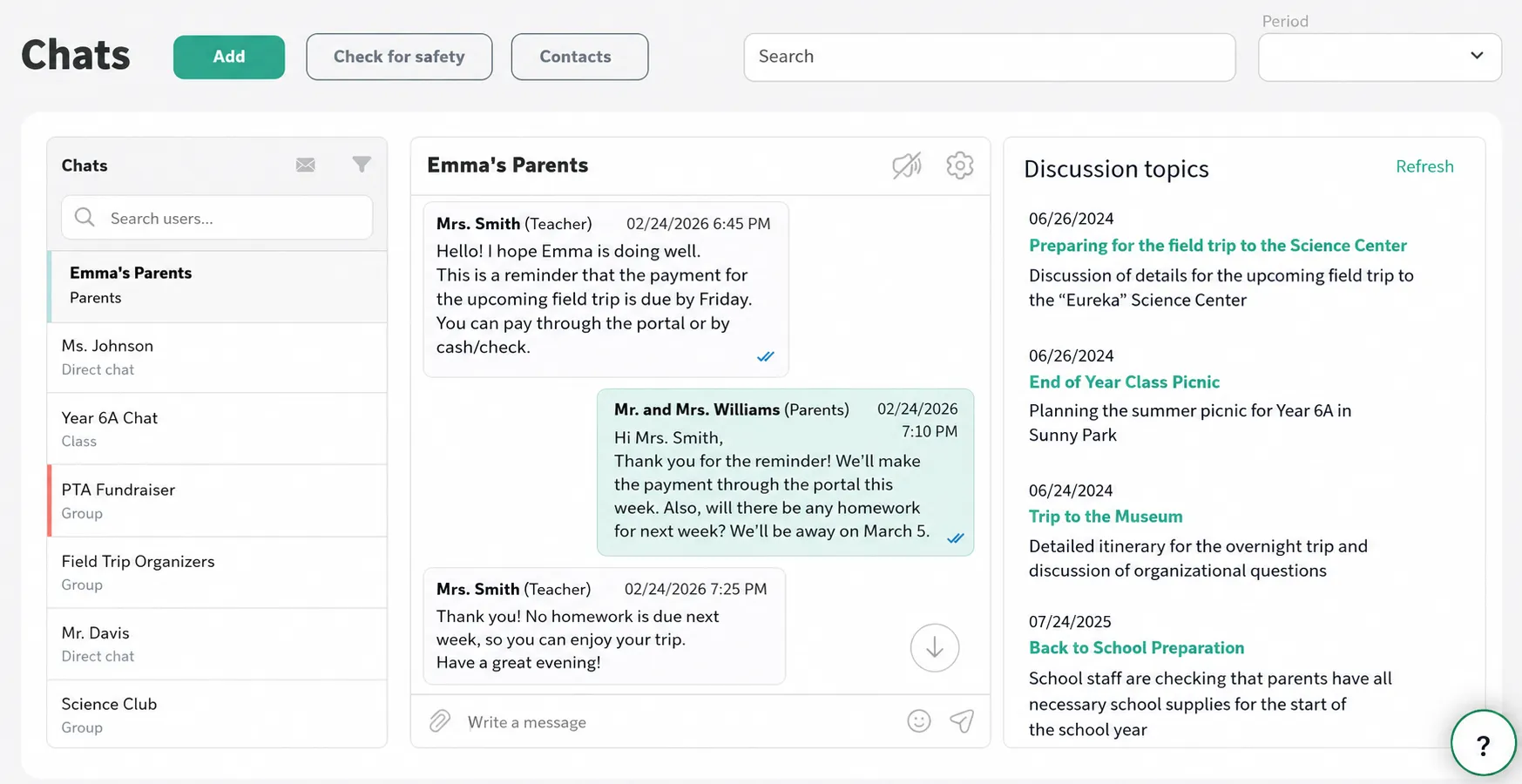
This is the principle guiding the development of Mojo. The platform brings together key information about a child’s school life and helps structure communication so that parents can find their way around more easily, while schools can maintain a consistent and transparent dialogue with families.
Ultimately, technology should not make communication more complicated; it should make it calmer and easier to understand. Because effective school communication does not begin with a new channel or yet another notification. It begins with understanding what families genuinely need to know.